







The scenery is offered in two versions sold separately, one for FS2004 and another for FSX.
Each version is sold for US$ 17.50
Current Version: 1.5
Publication Date: 2013.06.08
Download free upgrade to v1.5 here.
BluePrint’s version of KMCO offers the most accurate, up to date (when updated to version 1.4, see above) and detailed rendition ever offered. Located in central Florida, MCO is the gateway to one of the most comprehensive and popular entertainment destination in the world. Thanks to its unique design, it has managed to maintain a relaxed atmosphere typical of smaller regional airports. Nonetheless, it has nearly one hundred airline gates that stay busy throughout the day. Served by most domestic and numerous international airlines, MCO offers non stop flights to every major airport in the US and Canada plus numerous destinations in Europe, Central and South America.
MCO's passenger facilities consist of a central terminal linked via independent people movers to four remote concourses or airsides. No detail was spared in the rendering of each of the four airsides. The older Airsides 1 and 3 share style and design and they were both renovated recently. They are portrayed incorporating the most recent improvements. Significant changes affecting these facilities (updated in v1.4) include consolidation of the New United Airlines operations at Airside 3 and JetBlue move to Airside 1 (from Airside 2) to accommodate its increasing international service from MCO. Airsides 1 and 4 offer passport control and customs facilities.
The relatively newer Airsides 2 and 4 are very different from each other and the older ones. Each has been modeled as accurately as possible. Airside 4 was originally designed to accommodate the once significant Delta Airlines operations as well as to offer more convenient and modern international arrivals facilities. Delta is now the only domestic carrier using Airside 4 as AirTran returned to Airside 2 after being acquired by Southwest Airlines. Airside 4 also receives the major European airlines serving MCO, the most frequent visitor being Virgin Atlantic.
Finally, Airside 2 is the newest and was originally designed to serve low-cost domestic airlines. It is currently used by Southwest Airlines (and the remaining AirTran operations) and the newest domestic airline serving MCO, Virgin America.
The main terminal building is significantly less esthetically appealing than most as it appears to be just a hotel next to a huge parking structure flanked by two parking decks. Nonetheless, it has been rendered paying special attention to the few details that enhance its appearance which are essentially the four tram stations. An extra effort was also taken to accurately portray the massive parking facilities which are highly visible from all four Airsides and are an integral part of the airport’s character.
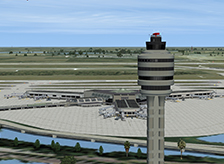
The air traffic control tower was used as the anchoring feature for this massive airport, even more so in this particular case as KMCO’s tower bears the distinction of being the tallest one in the United States (followed closely by another one of our favorites, KIND’s).
We have also rendered the general aviation, cargo and maintenance facilities located along the west end of the field. Despite some level-of-detail concessions made to accommodate the significantly more complex commercial passenger facilities, all significant structures were rendered including the Cessna/Citation training facility, the FedEx and UPS ramps, the Galaxy Aviation and Signature Flight Support terminals and hangars, and the general cargo area.
Finally, special attention was paid to the terrain representation. Accommodating rather than overpowering the typical Central Florida abundance of water, KMCO’s terminal and airsides intermingle with small lakes and wooded areas. Despite the terrain texturing and elevation detail limitations imposed by the simulators, we believe that we have managed to capture the unique look and feel of the airport as a whole.
Version 1.5.x free upgrade now available for download here.
The version 1.5 free upgrade is comprehensive and includes all previous updates. Changes and updates included in the upgrade are:
Changes implemented in v1.5
New 3D models for all four airsides with higher resolution textures
New, higher quality terrain replacement textures
New, higher quality ramp and taxiway markings and night illumination effects
Changes implemented in previous upgrades
Updated AFCAD file (“with airline gate assignments” option) and jetway configuration and branding to reflect recent changes at MCO, including:
- JetBlue (JBU) move from Airside 2 to Airside 1 (gates 1-9)
- New Virgin America (VRD) service from Airside 2 (gates 106, 108, 109)
- SWA/TRS gate consolidation at Airside 2
- UAL/COA gate consolidation at Airside 3
- DAL/NWA gate consolidation at Airside 4
- New Air France (AFR) service from Airside 4
- Various international carriers at Airside 1
- Frontier moved to Airside 3, Gate 35
- New Allegiant gate (Airside 1, Gate 11)
- Update to international airlines serving KMCO
Graphics display performance (frame rates) improvement is expected in most computers as a result of:
- Reformatted terrain textures
- Reformatted 3D models for all scenery components
- New approach lighting systems and runway threshold 3D models
- New custom-made and optimised static service vehicle 3D models
Scenery features
- Custom-made, optimised Gmax models of the three terminals, air traffic control tower, and all significant aircraft maintenance, cargo and general aviation facilities
- Custom-made, optimised textures for all Gmax generated buildings. In the FSX version, reflective effects were used in the textures of all major buildings
- Custom-made, high-resolution photo real ground textures in and around the airport including water effects
- Accurate runway and taxiway layouts, including detailed markings and signs
- Three levels of scenery complexity and detail:
- NORMAL complexity includes terrain texturing, autogen vegetation, airport layout with taxiway signs and basic navigation equipment models (actual localizer and glide slope radio signals are available regardless of the scenery complexity setting), most buildings within the field’s boundaries including the four terminals, the air traffic control tower and general aviation, cargo and maintenance facilities
- VERY DENSE complexity adds detailed instrument approach lighting system models, static ramp vehicles (optional) and infield trees (optional)
- EXTREMELY DENSE complexity adds elevated airport access roads. EXTREMELY DENSE complexity setting is recommended for computer systems equipped with advanced CPUs (Intel Core2 Quad) and video rendering resources (nVidia GeForce 8000 series or better). For suggested hardware configuration see below
- Custom-made, advanced AI mapping file including realistic gate and parking spot assignments*
- BluePrint Simulations sceneries are not compatible with FSX default animated service vehicles
* AI parking spots were fitted to accommodate specific aircraft models (including default MSFS aircraft) and we cannot guarantee that they will accommodate your favorite AI models. Customization and tweaking of the AI mapping file will most likely be necessary. Most gates were assigned to airlines operating at KMCO in the most accurate configuration possible based on information available to the public. Parking spot specs and gate assignments are available in the enclosed documentation.
Software Compatibility:
FS2004 (FS9) or FSX and all versions of Windows XP, Vista, 7 or 8Hardware Requirements:
For FS2004 (FS9)
- Intel Core Quad CPU or better (Q9300 @ 2.50 GHz fully tested)
- 4 GB RAM (fully tested)
- nVidia 9000 series video processor with 256-bit memory interface and 512 MB dedicated video memory or better (nVidia GeForce 9800 GT fully tested)
For FSX
- Intel Core i5 or better (Core i7-950 @ 3.07GHz fully tested)
- 4 GB RAM (fully tested)
- nVidia GeForce GTX 400 series* video processor or better (nVidia GeForce GTX 470 fully tested). Dual current generation nVidia* or ATI video processor in SLI or Crossfire configuration may be required for best performance when using the EXTREMELY_DENSE scenery complexity setting (2 X nVidia GeForce GTX 470 in SLI configuration fully tested)
Note: No measurable frame-rate degradation was observed using the hardware specified above as “fully tested”.
* BluePrint Simulations sceneries are designed and tested using nVidia GPU’s exclusively. For Current generation video card specifications visit nVidia.com. For ATI video card specifications visit ati.com
Airport Diagram and Approach Charts:
Approach charts for this airport can be found at: http://www.faa.gov
(Note: follow the link to “Free Online Products” and “digital – TPP/Airport Diagrams)
Airport Information
Location:
28
° 25.76'N
81
° 18.54'W
Elevation:
96 ft (29 m)
Runways:
17L/35R
9000 x 150 ft (2743 x 45 m)
17R/35L
10000 x 150 ft (3048 x 45 m)
18L/36R
12000 x 200 ft (3657 x 60 m)
18R/36L
12000 x 200 ft (3657 x 60 m)
Passenger Terminals:
Airside 1 (NW) (gates 1-29)
(JetBlue, American, Intl carriers)
Airside 2 (NE) (gates 100-129)
(Southwest, Virgin America)
Airside 3 (SW) (gates 30-59)
(United, US Airways, Spirit)
Airside 4 (SE) (gates 60-99)
(Delta, Intl carriers)
- Home
- Sceneries
- KSMF, Sacramento Intl
(New Release) - USA
- KSMF, Sacramento Intl
- KSJC, Mineta - San Jose Intl
- KLAX 2018 Los Angeles Intl v3
- KSNA, John Wayne - Orange County
- KSEA, Seattle - Tacoma Intl
- KCLT, Charlotte - Douglas Intl
- KSFO, San Francisco Intl
- KEWR, Newark Liberty Intl
- KDEN, Denver Intl
- KMSP, Minneapolis - St. Paul Intl v2
- KJFK, John F. Kennedy Intl
- KDTW, Detroit Metro
- KLAX, Los Angeles Intl v1 FS9
- KIAH, Houston Intercontinental
- KDFW, Dallas - Ft. Worth Intl
- KBOS, Boston - Logan Intl
- KMCO, Orlando Intl
- KMEM, Memphis Intl
- KIND, Indianapolis Intl
- KSDF, Louisville - Standiford Intl
- KIAD, Washington - Dulles Intl
- KDAL, Dallas - Love Field
- KRDU, Raleigh - Durham Intl
- KCLE, Cleveland - Hopkins Intl
- Canada
- South America
- Caribbean
- Europe
- KSMF, Sacramento Intl
- Buy
- Support
- Downloads
- FAQ
- Contact Us
- About Us